Wednesday, January 11, 2012

Trees: A good news and a bad news

It is quite a contrast to witness conflicting news on a same day. One of the Tamilnadu ministers announced in a program held in Avadi that 64000 saplings will be planted throughout Tamilnadu on the eve of celebration of 64th birthday of our Chief Minister, Dr. J. Jayalalitha. This is really a happy and good news to anyone who would like to save nature and create a healthy environment. On the same day that I heard this good news, I happened to read an article in Dinamalar, Tamil daily, which describes that 1000s of palmyrah trees are cut for the use of brick industry. It is a detailed report on the destruction of palmyrah trees in Krishnagiri district. This is an appeal to our state government as well as people of Tamilnadu. The article illustrates that the palmyrah toddy tappers, who are affected due to the seasonal employment, nature of the risky job, and the occupational hazards, do not want to continue the enterprise. So they cut and sell the celestial tree just for Rs.500/-. The worst factor is that owners of brick industry even go to an extent of destroying palm forests, which belong to the government. Cutting down trees from a land, not their own is not just unethical, also illegal. It is our duty to bring it to the notice of our government so that destruction of our state tree could be prevented.


Our team member, Mr. Sundaramoorthy, along with few other volunteers visited few rural villages of Virudhunagar District, where he witnessed the cutting of lots of palmyrah trees by palmyrah toddy tappers themselves. He narrated that in villages, particularly, in Vatthiraairuppu and Maelappatti, this is happening in great numbers. Followed by his report, we personally contacted the people from that locality and interacted with them to analyze the reasons for their indifferent attitude to the palmyrah tree. It is not only a seasonal unemployment, but also the tappers had forgotten the traditional techniques in growing the multipurpose tree which has lead to their poverty.

Its an absolute fact that palmyrah trees take 10 to 15 years to grow and yield products like ice apple, palm fruit, neera etc. Hence our ancestors had the scientific practice of growing intercrops along with these trees so that they could earn sustainable income. Moreover, palmyrah trees will only need water for one year. We conveniently forgot all these facts and all techniques are gone with the wind. The Dinamalar newspaper states that palmyrah trees grown on their own near the river banks prevent soil erosion are cut mercilessly. Tamilnadu and Puduchery recently encountered with the cyclone Thane. We have lost crores worth of wealth and loss of life. While we panic over this natural calamity, we could recall and refer the 2004 Tsunami, which struck the shores of Tamilnadu when Palmyrah trees on the seashore resist the force of Tsunami and save coastal villages like Manapadu in southern Tamilnadu. Whether flood or famine, palmyrah tree always play a vital role in saving the possession of people. For eg. some decades back, when Tamilnadu was affected by great famine, people as well as animal were fed by palmyrah stump.

Now we are involved in imparting the traditional knowledge of growing intercrops like plantain trees, millets in the palm grove so that the tappers could get sustainable income which paves way for reforestation.

The declaration of United Nations insist that any country should have one-third forest, but we have only 21% forest in our country.  Even in small countries like Japan, which have industrial developments possess 60% forest.  This is the right time to act by planting and saving trees, particularly, palmyrah tree, which does not require water, fertilizer, but has abundance of utility.  It is not only a tree, but an industry, which produces oxygen.


There are lots of people who are unable to afford basic amenities like food and shelter.  It is every man and woman's dream to have their own house.  Eco-friendly and cost-effective houses can be built with palmyrah leaves, wood, which is as strong as steel rods and beams.  It is good for tropical region like India since it moderates the temperature.

Monday, December 26, 2011

Palm Jaggery Coffee for Cold Season


Recently, the cold waves in India captures the headlines of most of the newspapers and television channels.  In many places the temperature goes into minus.  'The Hindu' titled the news as Capital's coldest Christmas in five years.  We feel the severe cold in southern parts of India also.  Many people are affected by cold, fall sick with terrific cough, fever, wheezing during this season.  Hospitals and clinics are flooded with sick people.  If anyone wants to get rid of cold and cough, prepare a coffee, a black coffee, with palm jaggery.  People may have questions while reading this, 'How coffee can be a remedy for cold?'  Before explaining making of this coffee, I would like to give the nutritive value of palm jaggery for you to have a glance.


Mahatma Gandhi said in praise of palm jaggery, "Neera can be converted as Jaggery, as sweet as honey itself.  This jaggery is superior to cane jaggery.  Cane jaggery is sweet, but palm jaggery is sweet and delicious.  Palm Gur gives mineral salts too.  Doctors have told me to eat jaggery and I always eat palm gur."


It is our traditional medicinal practice that for cold, people prepare 'Kashayam' made out of dried ginger, pepper, and thulasi leaves, but most people, particularly children, show the distaste on their face.  So, instead of this 'kashayam', we can make a black coffee with palm jaggery and dried ginger.


Now, let me give the recipe of Palm Jaggery Black Coffee


Ingredients:
1 liter water.
1 medium size palm jaggery (1/4 kg)
Dried ginger - small piece
Coffee powder - 2 tablespoons


Pour 1 liter water in a vessel and heat it up.  Break the palm jaggery into pieces and put it in the boiling water.  Add the dried ginger when the jaggery mix is still boiling.  When the jaggery and dried ginger is mixed very well in the hot water, put 2 tablespoons of coffee powder.  Put off the flame.  Hot palm jaggery black coffee is ready.  It can be served in 5 - 6 cups.


If somebody does not like black coffee, milk can be added.


Try this coffee daily morning and evening and see the result.  Cold or cough would not dare to touch you.


The neera season has just got over and we can get fresh palm jaggery from the palmyrah tree toddy tappers.  Why don't you try the black coffee.


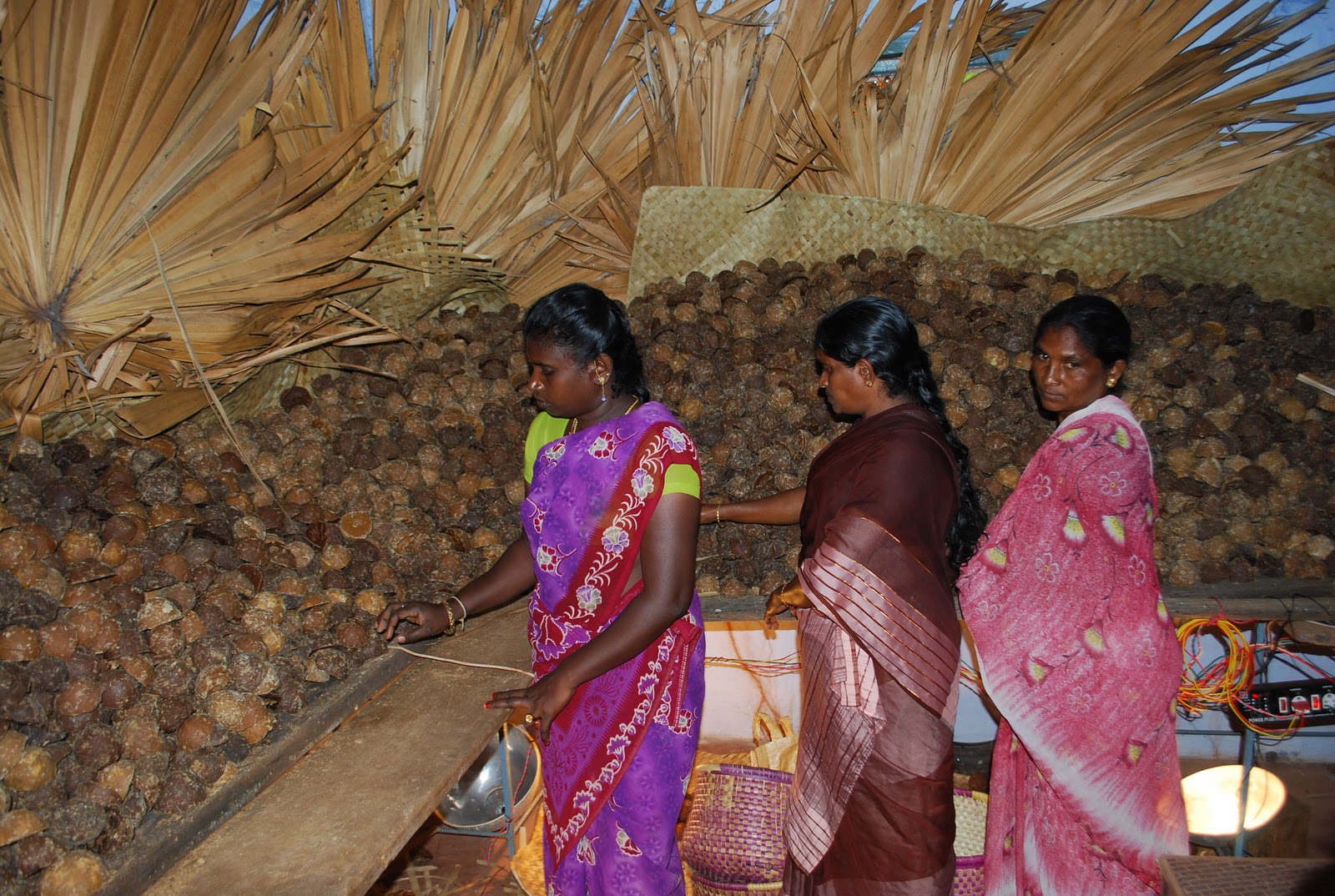
heap of palm jaggery


Palm jaggery prevents cancer, cures asthma, and is good for strong teeth and bones.
Let me again quote Mahatma Gandhi:  "Nature has made this product in such a way that it cannot be manufactured in the mills; it is produced in the cottages, where there are palm trees.  There, this jaggery can be easily produced.  It can be produced worth crores of rupees.  This is the way to banish poverty from the land.  This also is an antidote to poverty."


Let us use our natural resource for a healthy life and contribute to the needy economy of India.

Tuesday, December 6, 2011

Save Our State Tree - The Great Palmyrah


Recently, the Chennai city witnessed an hot debate on the extraction of toddy or ban on toddy where a group of people for extraction and few against.  One among the speakers were Mr. Kumari Anandhan, the former president of Tamil Nadu Congress Party and former Chairman of Palmyrah Welfare Board of Tamil Nadu Government.  This debate has been on for many years.  The first ban was in place by the British Government in 1921 and later on, it was revoked.  After independence, it was insisted that the palmyrah tappers' must obtain license, otherwise, the trade would be illicit.  This put intense pressure on the poor palmyrah workers.  In the year 1987, when the foreign liquor was allowed, a total ban on toddy extraction was imposed. People who are FOR extraction of palm toddy argue that palm toddy contains only 4.5% of alcohol and also refer the report of Justice Sivasubramanian commission, which recommends that toddy tapping is not illegal and toddy itself is a frothy drink food for locals.

From my own experience, working with palmyrah toddy tappers,  wherever I go for the field work, I happen to see the frustration of the tappers.  The agitation is still on against the ban on toddy tapping.  Me, along with my students, young volunteers would never plunge into that debate.  At the same time,  we understand their problems of frequent harassment from police for not having licences or sometimes arrest even if they have license suspecting that they are extracting toddy.  The major setback for them is their classification under Kadhi and not in agriculture sector. That is why, we organized the so-called existing associations for palmyrah tappers, but not functioning effectively and invited government officials, including police for constructive discussions.  To distribute micro-credit for palmyrah tappers, we involve local police for the program to build an understanding.


From my own observations for the past seven years, palmyrah trees and tappers' trade can be saved if we adapt some logical methods where we could also ask for government help.

1.  The major thing to be debated in various platforms is the inclusion of palmyrah tree and trade in agriculture sector by the government so that the tappers could avail all the facilities like subsidies from the government, which is given to small farmers.

2.  The forgotten techniques like growing intercrops with palmyrah trees can be taught to the tappers to earn substantial and additional income, which in turn would redeem them from loans.  Moreover biodiversity also can be preserved by adapting this method.

3.  Awareness should be created among tappers through workshops and programs that palmyrah tree is an income-generating tree.  For this, market space should be created for all palmyrah food products like neera, palm candy, jaggery, ice apple, and palm fruits through innovative methods.

4.  The present government has ordered to distribute mango juice to the balwadi children and school children along with mid-day meals.  As Mr. Kumari Anandhan has said, neera also can be kept in TetraPak and distributed to children because it contains lauric acid which is found in breast milk.  It is good for bone, memory power, and eyesight.

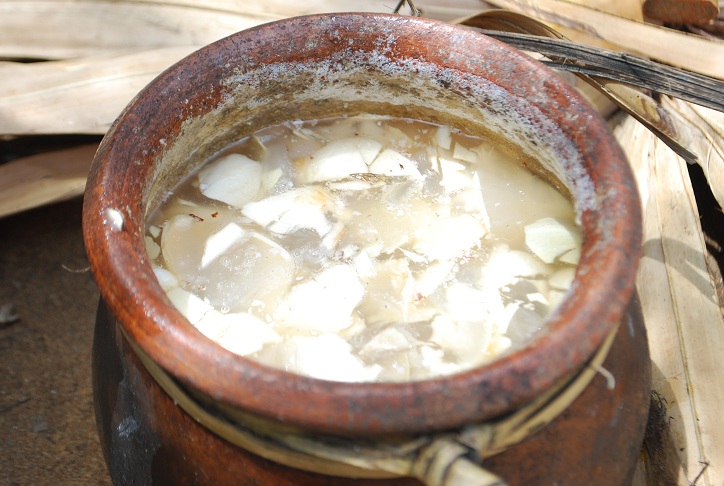
Neera with ice apple (nungu) in an eco-friendly pot
5.  Researchers in technology can be motivated to design an instrument to extract neera from palmyrah tree which would ease the risky job of tappers.


Along with my team, I tried several methods to encourage the tappers in their trade.  Through various steps like microinsurance, micro-credits, and developing innovative produce from the traditional palmyrah products, we are able to turn them into successful entrepreneurs in few villages of Tamil Nadu.  For example, we innovated a bread-spread from the traditional 'paagu' by mixing fruits like mango, papaya, and banana.  It is well-received by school children, adults, and even diabetic patients.  When I interacted with the palmyrah association leader in Tuticorin, he came forward with the idea of making flour from panankizhangu to make our traditional and tasty food and snacks like idli, upmaa, dosai, and murukku.  Even neera can be converted into powder by which we can make mix.  Researchers should come forward to analyze such products.

I strongly believe that only practical orientation could help palmyrah tappers to save the glorious palmyrah tree as well as their trade.  It is my long dream to have a model palm grove, where we can impart the technical skills to the tappers.  In this process, we have applied for Rolex Awards for Enterprise 2012, which support individuals, who involve themselves in creating better tomorrow for human kind.  From 1978, environmental projects have been awarded for 38 individuals.  Our project for palmyrah tree, which preserves the ecological balance, also has been selected in the pre-application process and I was invited to submit a full proposal, which I did.  When I share this privilege with environmental well-wishers, I urge everyone to take steps to save our state tree, which has 2500 years of history in our life, culture, and heritage.

***

Thursday, November 24, 2011

Recipe for Palm Leaf Kozhukattai


Ingredients:
Hand-ground raw rice flour - 1 kg
Palm jaggery in liquid form (vaarpu karupatti) - 3/4 kg
Grated coconut - One
Tender palm leaves - as required (minimum 25 to 30)


Method:
Mix the rice flour with vaarpu karupatti (liquid form of palm jaggery preserved in clay pot) and coconut, if required, add some water.


Clean the palm leaves and cut the center portion about 4 to 5 inch long.


Open the leaves and stuff the dough lengthwise and close the leaves. Tie with a thick thread. (You can use thinly cut palm leaves as thread). Finish all the dough like this.


Take a clay pot, pour water, keep small sticks and spread some palm leaves.  Then keep the kozhukattai preparations to boil in steam.  When it gets cooked, it is ready to eat. 


If you would like to keep it for 3-4 days, remove the palm leaves from cooked kozhukattai and keep it in a solavu (winnower) made out of palm leaf in an airy place.

Lighting Karthigai Dheepam with Palm-Leaf Kozhukattai


Kaarthigai Deepam [கார்த்திகை தீபம்] (celebrated December 08 in 2011),  is a festival of lights, celebrated in the Tamil month of Kaarthigai (Nov 17 - Dec 16 this year). It is celebrated on the full moon day of the Kaarthigai month.  In southern Tamil Nadu, it is a traditional practice that people make delicious 'panai olai kozhukattai' [பனை ஓலை கொழுக்கட்டை] made out of rice flour mixed with palm jaggery.  It is not only sweet, also sugar free, since the palm jaggery doesn't stay in the body.  This food is highly nutritious, which contains minerals and vitamins.  The speciality of this kozhukattai is that it is prepared covered by palm leaves and boiled in a pot; so it is eco-friendly.  Even today I could feel the taste of the kozhukattai with sweet smelling palm leaves.  It is culture-related.

We are to celebrate the festival in another few days, but I wonder if anyone will prepare this delicious panai-olai kozhukattai.  Even if so, they can be numbered.  Even if somebody wants to make this kozhukattai, where will they go for palm leaves?  No leaves?  Few years back, in southern districts, the community of palmyra tree toddy tappers used to make panai olai kozhukattai.  Also, it was easy for people from other communities to get palm leaves and palm jaggery to cook kozhukattai.  The toddy tappers would happily supply the palm leaves free of cost for brotherhood.  The situation has entirely changed now.  Very rarely the leaves are available in the market during this season.

People are not aware of the medicinal values of palm jaggery.  Its not just food.  Hence this practice, which was inseparable in our culture and heritage is slowly disappearing.  I am indeed panic over the fact that palm forests are destroyed.  Recently, I was discussing this issue with a celebrity, who also had similar painful experience of witnessing the deforestation of 45 acres of palmyrah forest, some years back in his birthplace, Sundaranachiyarpuram [சுந்தரநாச்சியார்புரம்].  Catholic priests those days felt that palmyrah toddy tappers are ruining their life and health by consuming palm toddy, which they considered as alcohol.  They thought they'll redeem the people from the practice by destroying the palmyra forest.  At least 8500 trees were cut.  Each tree takes minimum of 12 years to grow and yield.  They did not realize that it is not destruction of palmyra forest, but survival of a community, healthy environment, healthy food, medicine, and culture & heritage.  At the same time, the celebrity agreed with me that to change the practice of taking toddy, the palmyrah trees need not have been removed from Sundaranachiarpuram.  Our ancestors have taken pure toddy which is good for health.  If toddy is taken continuously for 40 days, it is good for eye sight.

Sweet idli, aappam, Toddy was used to make the mix sour.  Now yeast has replaced.  
During every season, we get some edible things from palm tree:
- From March to August, we get 'neera', contains lauric acid, which is found in breast milk.  So, its a natural health drink even for children.
- Palm jaggery and palm candy made out of boiled neera are good for cold, cough, asthma, cancer, and diabetes.
- Palm jaggery is preserved in another liquid form called 'vaarpu karupatti' in pots which they use for making sweets.  Whereas, palm jaggery is mostly used for making coffee.  This black coffee without milk can be consumed hot or cold anytime.
- Ice apple (nungu) is a cure for all diseases caused by heat in the tropical region like small pox.
- Palm fruit is not only tasty, but highly nutritious.

panankizhangu

- In the next season, i.e., from December to February, we get calcium and fiber-rich 'panai kizhangu', which is good for digestion.

In the life of Tamils, during all auspicious days, palm tree plays an inevitable role.  For marriage, palm fruits are used for decoration symbolizing the fullness of life.  A newborn Baby is given jaggery mixed with water as blessings from elders.

During Pongal festival, which is meant for Tamils, parents would present women colorful 'Seer Petti', a box made out of palm leaves filled with rice, sugar, coconut and other grocery essentials.  Now the colorful palm leaf boxes are replaced with harmful plastic buckets in this modern world.

It is high time to think about the emerging danger of losing palmyra trees, culture & heritage, survival and livelihood of palmyra tree toddy tapping community, which depends on palmyra trees for centuries.  When we welcome the modernity, let us take a pledge during this Karthigai Deepam, to go for reforestation of palmyra, our 'State Tree'.  Otherwise, we could witness the extinction of palmyrah trees which already happened in our neighbourhood state, Kerala.  As I conclude, let me remind volunteers of our Blaze Trust to join during Christmas holidays with us to spend with palmyra community, particularly with children.  Wish you a Happy Karthigai Dheepam. 

Saturday, November 12, 2011

Children Parliament

- Palmyrah Community Children Program -

We are constantly focussing on children parliament program for palmyra toddy tappers’ community children.  The children, who are entrusted with portfolios with education, environment, and health & sanitation, are seriously taking their assignments and doing amazing work in the localities.  Amidst the palmyrah toddy tapping hamlets, these children are encouraging the enrolment of dropout children to schools, thereby helping us in our mission of eradicating child labor, which is more prevalent in this community.


One group of children are following the environmental impact of our project.  They are very much delighted to do this work like monitoring the increased number of birds in the surroundings of palm forest and also change the mindset of the people of the community to go for solar lanterns to use during the season in the thatched huts in the middle of forest instead of risky and polluting kerosene lamps.  Hence now it is time for us to generate funds for the distribution of solar lanterns to the community before the starting of next season.


In some areas, plastic garbage are found along on the way to palm forest.  These children are motivated to clean and have green surrounding by planting palm seedlings.

We have decided to celebrate our Christmas and invest the whole of Christmas holidays along with the palmyrah toddy tappers, particularly with the children.  The important agenda is not only to conduct awareness program on their surroundings and environment, but also to take them to nearby eco-tourist spots like Manappaadu, a natural beach.  This beautiful place has its own heritage for palm crafts where women from fisherfolk community as well as palmyrah toddy tapping community are trained to make handicrafts from palmyrah leaves. We also planned to deepen the existing ponds in that area with the help of youth and children.  Apart from our members, whoever is interested to join in this venture can enrol their names by e-mailing us at TrustBlaze@gmail.com. This is an open invitation to take part in this noble mission.

Blaze Trust


- Another milestone in our journey -

I am immensely happy to announce to all the volunteers, animators, students, who immersed themselves in the projects, which we are executing in Southern Tamil Nadu, particularly for the partakers of the one that we are doing from the year 2005 for palmyrah toddy tapping community, the formation of our Trust - ‘Blaze.’

Your are playing a very vital role in the field works, workshops, awareness programs on palmyrah tree and its embodiment with the environment.  The recent update from palmyrah toddy tappers community from Chettivilai locality stands a witness to successful implementation.  The palmyrah season just got over, which started in the early March.  Our community are able to store their produce by following the traditional technique of storage revived and taught by us.  Hence, they are happy that they can get fair prices for their produce during the off-season.  You all will be happy to know that they came out of the clutches of the moneylenders and they all have bank savings now.

Palmyrah tappers in Karupur

Hope you all remember that this is the community which questioned us when we insisted on savings during our financial literacy programs, “We are struggling for one meal a day and you are talking about saving money in the bank.  That too, we live in a remote village where there is no bank at all.”  This magical change is done by all our systematized, and well organized implementation of the project.

Happy Women from palmyrah community in an eco-friendly store room

We all felt that we can form an organization to carry out our project in a more effective and efficient manner.  After repeated discussions with all animators, volunteers, and the community leaders, palmyrah federations (that we formed), it is decided to go for a registered foundation.  Yes, due to our continuous effort, our Trust ‘Blaze’ is formed.  Hence, now we can go ahead with more enthusiasm.

While thanking all the active participants of this project, I earnestly request everyone to be with us and bestow your innovative ideas.