Showing posts with label palmyrah. Show all posts

Wednesday, January 11, 2012

Trees: A good news and a bad news

It is quite a contrast to witness conflicting news on a same day. One of the Tamilnadu ministers announced in a program held in Avadi that 64000 saplings will be planted throughout Tamilnadu on the eve of celebration of 64th birthday of our Chief Minister, Dr. J. Jayalalitha. This is really a happy and good news to anyone who would like to save nature and create a healthy environment. On the same day that I heard this good news, I happened to read an article in Dinamalar, Tamil daily, which describes that 1000s of palmyrah trees are cut for the use of brick industry. It is a detailed report on the destruction of palmyrah trees in Krishnagiri district. This is an appeal to our state government as well as people of Tamilnadu. The article illustrates that the palmyrah toddy tappers, who are affected due to the seasonal employment, nature of the risky job, and the occupational hazards, do not want to continue the enterprise. So they cut and sell the celestial tree just for Rs.500/-. The worst factor is that owners of brick industry even go to an extent of destroying palm forests, which belong to the government. Cutting down trees from a land, not their own is not just unethical, also illegal. It is our duty to bring it to the notice of our government so that destruction of our state tree could be prevented.


Our team member, Mr. Sundaramoorthy, along with few other volunteers visited few rural villages of Virudhunagar District, where he witnessed the cutting of lots of palmyrah trees by palmyrah toddy tappers themselves. He narrated that in villages, particularly, in Vatthiraairuppu and Maelappatti, this is happening in great numbers. Followed by his report, we personally contacted the people from that locality and interacted with them to analyze the reasons for their indifferent attitude to the palmyrah tree. It is not only a seasonal unemployment, but also the tappers had forgotten the traditional techniques in growing the multipurpose tree which has lead to their poverty.

Its an absolute fact that palmyrah trees take 10 to 15 years to grow and yield products like ice apple, palm fruit, neera etc. Hence our ancestors had the scientific practice of growing intercrops along with these trees so that they could earn sustainable income. Moreover, palmyrah trees will only need water for one year. We conveniently forgot all these facts and all techniques are gone with the wind. The Dinamalar newspaper states that palmyrah trees grown on their own near the river banks prevent soil erosion are cut mercilessly. Tamilnadu and Puduchery recently encountered with the cyclone Thane. We have lost crores worth of wealth and loss of life. While we panic over this natural calamity, we could recall and refer the 2004 Tsunami, which struck the shores of Tamilnadu when Palmyrah trees on the seashore resist the force of Tsunami and save coastal villages like Manapadu in southern Tamilnadu. Whether flood or famine, palmyrah tree always play a vital role in saving the possession of people. For eg. some decades back, when Tamilnadu was affected by great famine, people as well as animal were fed by palmyrah stump.

Now we are involved in imparting the traditional knowledge of growing intercrops like plantain trees, millets in the palm grove so that the tappers could get sustainable income which paves way for reforestation.

The declaration of United Nations insist that any country should have one-third forest, but we have only 21% forest in our country.  Even in small countries like Japan, which have industrial developments possess 60% forest.  This is the right time to act by planting and saving trees, particularly, palmyrah tree, which does not require water, fertilizer, but has abundance of utility.  It is not only a tree, but an industry, which produces oxygen.


There are lots of people who are unable to afford basic amenities like food and shelter.  It is every man and woman's dream to have their own house.  Eco-friendly and cost-effective houses can be built with palmyrah leaves, wood, which is as strong as steel rods and beams.  It is good for tropical region like India since it moderates the temperature.

Tuesday, December 6, 2011

Save Our State Tree - The Great Palmyrah


Recently, the Chennai city witnessed an hot debate on the extraction of toddy or ban on toddy where a group of people for extraction and few against.  One among the speakers were Mr. Kumari Anandhan, the former president of Tamil Nadu Congress Party and former Chairman of Palmyrah Welfare Board of Tamil Nadu Government.  This debate has been on for many years.  The first ban was in place by the British Government in 1921 and later on, it was revoked.  After independence, it was insisted that the palmyrah tappers' must obtain license, otherwise, the trade would be illicit.  This put intense pressure on the poor palmyrah workers.  In the year 1987, when the foreign liquor was allowed, a total ban on toddy extraction was imposed. People who are FOR extraction of palm toddy argue that palm toddy contains only 4.5% of alcohol and also refer the report of Justice Sivasubramanian commission, which recommends that toddy tapping is not illegal and toddy itself is a frothy drink food for locals.

From my own experience, working with palmyrah toddy tappers,  wherever I go for the field work, I happen to see the frustration of the tappers.  The agitation is still on against the ban on toddy tapping.  Me, along with my students, young volunteers would never plunge into that debate.  At the same time,  we understand their problems of frequent harassment from police for not having licences or sometimes arrest even if they have license suspecting that they are extracting toddy.  The major setback for them is their classification under Kadhi and not in agriculture sector. That is why, we organized the so-called existing associations for palmyrah tappers, but not functioning effectively and invited government officials, including police for constructive discussions.  To distribute micro-credit for palmyrah tappers, we involve local police for the program to build an understanding.


From my own observations for the past seven years, palmyrah trees and tappers' trade can be saved if we adapt some logical methods where we could also ask for government help.

1.  The major thing to be debated in various platforms is the inclusion of palmyrah tree and trade in agriculture sector by the government so that the tappers could avail all the facilities like subsidies from the government, which is given to small farmers.

2.  The forgotten techniques like growing intercrops with palmyrah trees can be taught to the tappers to earn substantial and additional income, which in turn would redeem them from loans.  Moreover biodiversity also can be preserved by adapting this method.

3.  Awareness should be created among tappers through workshops and programs that palmyrah tree is an income-generating tree.  For this, market space should be created for all palmyrah food products like neera, palm candy, jaggery, ice apple, and palm fruits through innovative methods.

4.  The present government has ordered to distribute mango juice to the balwadi children and school children along with mid-day meals.  As Mr. Kumari Anandhan has said, neera also can be kept in TetraPak and distributed to children because it contains lauric acid which is found in breast milk.  It is good for bone, memory power, and eyesight.

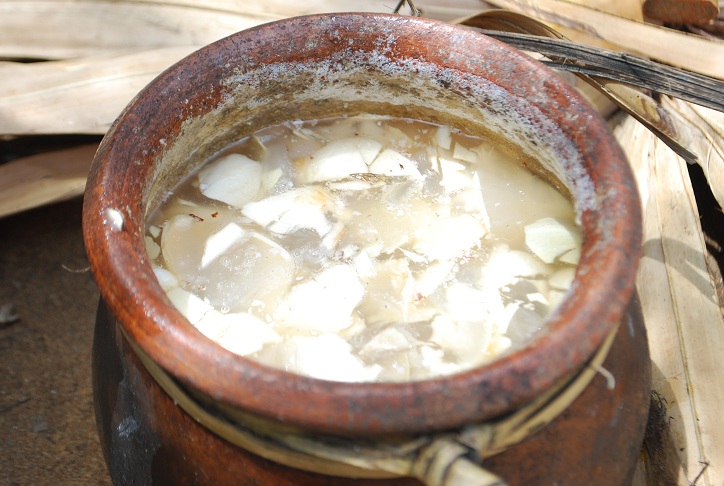
Neera with ice apple (nungu) in an eco-friendly pot
5.  Researchers in technology can be motivated to design an instrument to extract neera from palmyrah tree which would ease the risky job of tappers.


Along with my team, I tried several methods to encourage the tappers in their trade.  Through various steps like microinsurance, micro-credits, and developing innovative produce from the traditional palmyrah products, we are able to turn them into successful entrepreneurs in few villages of Tamil Nadu.  For example, we innovated a bread-spread from the traditional 'paagu' by mixing fruits like mango, papaya, and banana.  It is well-received by school children, adults, and even diabetic patients.  When I interacted with the palmyrah association leader in Tuticorin, he came forward with the idea of making flour from panankizhangu to make our traditional and tasty food and snacks like idli, upmaa, dosai, and murukku.  Even neera can be converted into powder by which we can make mix.  Researchers should come forward to analyze such products.

I strongly believe that only practical orientation could help palmyrah tappers to save the glorious palmyrah tree as well as their trade.  It is my long dream to have a model palm grove, where we can impart the technical skills to the tappers.  In this process, we have applied for Rolex Awards for Enterprise 2012, which support individuals, who involve themselves in creating better tomorrow for human kind.  From 1978, environmental projects have been awarded for 38 individuals.  Our project for palmyrah tree, which preserves the ecological balance, also has been selected in the pre-application process and I was invited to submit a full proposal, which I did.  When I share this privilege with environmental well-wishers, I urge everyone to take steps to save our state tree, which has 2500 years of history in our life, culture, and heritage.

***

Friday, August 12, 2011

My Grandma and Palmyrah!

My maternal Grandma, Magadalena Mary, was my best friend from my childhood who taught me the philosophy of life.  She was a mother of 11 children and grandmother of 48, but I am certain that I was the most favorite among them all.  I was not regular to school till Standard IV (middle school), but learnt a lot from her.

There were various kinds of trees & flowers in her home.  The most fascinating favorite, for me, was the palm tree in the backyard.  There was a well without walls, but full with water anytime of the year.  She'll make me to sit under this palm tree while washing the vessels.  This was the time that I had the opportunity to listen to some most interesting stories.  While listening to her stories, I'll enjoy watching birds like palm swift building their nest.  Most of the time, ripened ice apple ('Kadukaai', கடுக்காய் in Tamil) falls from the tree.  I would run to pick it and eat, but my Grandma would never allow me to eat them.  The reason she would tell me, "Ice apple is good for health, but not Kadukaai (ripened Ice apple).  It will cause stomach ache."  Her explanation would not suffice the adamantly screaming child that wants to eat them.  Grandma immediately would ask my uncle to bring ice apples from her palmyrah tree farm.  Imagine a 3-year-old kid eats 10 to 15 ice apples a day!  But that was what I was having for my breakfast, no wonder.  And there brings grandma, my coffee, made of palm jaggery.  Oh! how I love it!  The very taste still waters my mouth.  When its eleven in the morning, I'll get hot 'padhaneer kanji' (பதநீர் கஞ்சி) made out of the natural drink neera from palmyrah and rice.  In the evening, I get palm 'kilangu' பனங்கிழங்கு and palm fruit.  Needless to say, I grew up as a healthy girl getting all the nutrition / vitamin from all edibles from the palm.  The palm fruit, especially, is very delicious.  It subsides the excess heat generated in the body.

Panai Jaggery is being prepared from Palm Juice

Every year, my grandma used to plant new palm saplings.  I remember, once, I asked her this question, "Why are you doing it as a custom?"

Her answer was, "Don't you like the palm fruit?  ice apple? palm candy?"


"I love them grandma!"  I answered.


She then asked me "Don't you like the pond of our village?"

"Sure!" I said, "Its full with beautiful lotus.  The ever-living waters where you taught me swimming."

Now she said, "To save the traditional tree which is bound to our culture and heritage, my dear, we need to plant more."  She went on to say in her own style, "Planting palm tree preserves mother earth, nature, the water bodies like our village pond.  Do you know, my child, this tree is the best friend of mankind?  Let me tell you... each and every part of this tree is used in one way or other."

Yes, what my grandma said was absolutely correct.  Even now, as I re-live that evergreen talk, I remember, I was fanning the breeze with palm leaf!


Not long after that conversation, it was time for my grandma to say goodbye to this world.  After her, I was brought up in town and never wanted to visit the village again.

Several years later, I had to visit the same village for some cause.  Wait...! Did I say 'same village'?  No, it wasn't the same.  While my heart pounded to see that pond, that palm tree, and the beauty of the place, I never thought that I would see what I saw.  To make the long tragedy short, most of the palm trees in that village were cut, for money, by the farmers themselves who planted it.  They've gone to look for alternative trade.  I couldn't locate the pond.  People showed me a thorn bush and said that's where the pond used to be.  I had to return absolutely disheartened.  Since then, my mind was contemplating over this loss and I ended up making a decision.

Not long after..., I started learning the uses of palm tree and started working with the palmyrah farmers.  Thanks to my profession, being a professor, I invest at least a part of my lecture, to inculcate environmental consciousness, awareness, and values.  For the past six years, I have engaged my beloved student community with palmyrah tree toddy tappers in Tirunelveli and Tuticorin Districts.
Me and my students with palmyra toddy tapper in the field.

I gratefully acknowledge my friends and supporters, Dr. Sethu Kumanan, Chairman, Sethu Bhaskara Group of Institutions, Mr. Bharathi, Director, RUDSET, and my co-worker, Samson.  Now, I am happy to see my grandma's assignment continued with farmers planting palm seedling.  This has made me feel that I have successfully crossed few milestones, but I agree with Robert Frost when he says, "Miles to go before I sleep."

The palmyra tree is one of our nature's best defense mechanism that can be saved; as well as our planet.