Thursday, February 4, 2016

Research article on my Novels 'BARANI',' KILIYAMMA ENTRA KUMANA' and my short story collection 'KADAULIN KAADAL KADITHANKAL' by Prof Jeyasing, Rex,Dept of Electronics MediaST.Thomas college

Josephine Jeyashanthi
- A Harbinger of Hope in Tamil Post-modern Literature
Within the broad spectrum of recent women's writing throughout the world, in west and east, there are elements of both continuity and change, but if the 1980s bears a distinctive mark, it may be seen in the emergence of what can be termed 'postmodern' feminist literate.  By ' postmodern' I mean literature which reflects a skeptical attitude to the existence of general, all-encompassing principles governing our natural and social reality.  For feminism this implies avoiding the construction of theories of women's oppression which merely generalize from the experience of white, Western, middle-class women.  To this extent, there is less evidence of the lack of simultaneity which, Sigrid Weigel argues, separated feminist theory and much textual practice in the previous decade.  Whilst many of the older generation of post-war writers - Ingeborg Drewitz, Luise Rinser, Johanna Moosdorf and Eva Zeller - produced significant mature works, the work of several authors who began to publish in the 1980s reflects contemporary theoretical debates within postmodern feminism.  This is not to imply a consensus on the definition or usefulness of categories such as Frauenliteratur or Weibliche Asthetik.  Liberal and Marxist feminist voices in particular continued to protest against the 'ghettoisation' of women's writing, whether self-inflicted or imposed by a critical establishment which effaced the individuality and plurality of their literary production through their summary classification as women writers.

The very notion of 'feminity' as used in its political context by the women's movement has acquired a broader application in postmodern discourse.  As identity has been variously theorized as a complex effect of culture rather than an 'essence' at the heart of the individual, so the cultural suppression of the feminine may be understood as much more than the exclusion of women from positions of institutional power.  It is manifested in all attempts to marginalize difference in the increasingly homogeneous, market-orientated societies of the capitalist West.

The question of Indian postmodernism is objected for many reasons.  The situations in the East and West are in many respects so different that the application of postmodernism to the Indian context is not warranted at all.  It is usually argued that Postmodernism is primarily a Euro-American phenomenon, which arose, initially, as a significant counter-movement to the imperialist impulse behind Modernist politics, culture and aesthetics in the west whereas ours is a postcolonial culture, a victim of western imperialism.  In Lyotard's view, postmodernism is not to mean after - modernism but anamodernism.

Makarand Paranjape, however, concedes that postmodernism can have a use for us in India when it is viewed 'as a kind of social criticism' and advocates its use in India for ushering in glasnost and perestroika into our political and ideological institutions.  "The greatest restructuring can take place in our notion of authority, whether of the teacher or of the text.  Institutional and hegemonic readings have all but closed out access to the great texts of India; they need to be deconstructed both inside and outside the classroom."

Postmodernism, it becomes clear, is fully committed to accommodating the voices of the ex-centric and the marginalized.  Herein lies the close connection between feminism and postmodernism.  The women writer manipulates stances that critique domination and thus lays bare the multivocal worlds of different societies and different cultures.  Indian women writers assert that a Feminist theory should be explicitly historical, attuned to the cultural specificity of different societies and periods, and to different groups within societies and periods.  They wish to analyse the workings of patriarchy in all its manifestations, desire to think in terms of pluralities and diversities rather than unities and universals and articulate ways of thinking about gender without simply reversing the old hierarchies or confirming them.

In this context, south Indian postmodern feminist author, Josephine Jeyashanthi plays an important role in bringing out the voiceless voice of oppressed women by way of caste system that prevails strongly in southern Tamil Nadu.  In her writings, she has exerted her energy to deconstruct the past, reconstruct a more meaningful present.

Barani, a full-length novel written by her is a neo-Dalit novel.  Veteran writer on Dalits Sivagami I.A.S. has described this novel as a pro-Dalit novel which triggers questions on intercaste marriages, which was introduced by reformers as powerful way to eradicate caste system.

The social tensions, the prejudices, the conflicts, the violence and the exploitation, the arrogance of power, the pathos of unmerited suffering, the thirst of the under dogs for freedom from oppression and marginalization, their determination and courage for self-assertion, the rise of the subaltern groups, the emotional turbulences, the personal growth and maturation through conflicts and difficulties, the strength and creative force of human relationships and concern, the beauty of tolerance – any of us in Tamil/Indian society today could have experienced these. The story is a mirror to life today.

The characters are real to life. We can meet them on the streets as we go round our daily rounds of occupations. The wisdom of the old, the idealism and aggressively of the young, the play fullness of the children, the uncaring cruelty of the powerful, the moral degradation of the oppressor, the prudent fear of the down-trodden, the ambiguities and compromises of the do-gooders, the communalistic abuse of religion, the social sense and the spirit of reform and reconciliation of a few true leaders come through the characters very powerfully and poignantly.

The problems that the story evokes have become perennial. The oppression and degradation of the Dalits, the subjugation and exploitation of women and the competition of social groups for scarce resources are portrayed vividly. 

The foibles and deviations of the Christian institutions are held up the cold light of day. Nature’s attractions and the human joys, sufferings, evil and violence of village life are engagingly pictured.   

The seeming digression of the narrative into Srilanka and Nagaland show that the human problems, discriminations and violence are the same everywhere, even though they may take different forms under even though they may take different forms under different circumstances and have different histories.

This is good Novel. It could be a true story. So it makes us pause and think. It challenges us to action. It does not deaden our senses in an unreal and imaginative world. It turns around the oppression suffered by the Dalits, especially the Dailt women. It evokes their desire for identity and freedom, dignity and empowerment. Its call to reflection is also a call to discussion.

The main thrust of the story is that the oppressed cannot expect their freedom to be offered to them on a platter. They have to stand on their own and struggle for their liberation. This lesson is communicated, not through the depiction of some broad social movement, but by the personal experiences and reflection of a young, intelligent and sensitive girl, Barani (a character in the novel) though the fruit of an inter-caste marriage, she experience the ambiguity of such an identity. She identifies herself with the Delist and commits herself to the struggle for their liberation. She affirms this choice both by rejecting the possibility to settle down in a quiet but passive marriage with her cousin. The future is open. We can only wish her, and others like her in Tamil Nadu today, all the best in their struggle and promise to stand by them.

The inter-cast marriages have been suggested as one of the remedies for the caste discrimination against the Dalits by leaders like periyar. We have a milder version of this in the Sammathuvapurams of today. On the one hand, the inter-caste marriage can ideally break down the refusal to inter-dine and inter-marry. By mixing blood it attacks the principle of ethnic purity at its heart. But it has been claimed that the oppressed caste were originally the fruits of such mixed unions. So we are not going to correct the consequences by repeating the cause. In any case, a few symbolic missed marriages will be seen as exceptions that prove the rule. The children will have an ambiguous sense of identity and will eventually merge into one of the castes,  probably the lower one in the hierarchy. Inter-caste marriages can be a solution only if they happen on a large scale so as to break down all the fault-lines and barriers of a rigid hierarchical system. We can understand the feeling of Barani in the matter and sympathize with her decision.

The self-assertion of Barani of her identify  certainly deserves appreciation and support. The oppressed have to lead their own struggles. They do not need our paternalistic sympathy. But they need not be helpless, but goodwill who have, in their own minds, transcended the structures of the cast system.

Barani and shenbagam, her mother, are liberated people, in spite of the pain and the discrimination that they had to go through. but they would not be what they are without the help and empowering relationship, not to speak of the love, of sivanesan, Barani’s father and other friends like him. Barani discovers many such empowering relationships that affirm her and support her in the course of her college life, in spite of seemingly inevitable caste group polarizations there. They certainly stand out, not only from the uncaring and unrepentant brutes who are the oppressors, but slso from the soft ones who seek a safe heaven far away from the field of battle 
.
 This experience points to a general principle. The caste system and other similar structures of discrimination are social system. Such social systems are not changed without some sort of a broad social consensus. This consensus itself will be the fruit of a struggle that eventually conquers, if it does not convert, the dominant and the powerful with their vested interests. But even a victory in conflict will not bring change it could make vested interests more rigid and intransigent, if there is a no middle group who create and shape a new consensus around a new social vision.
  
The discussions around the problems of multiculturalism one speaks of the need to recognize respect and accept the other cultures, especially the weaker ones. This is also true of the struggles against the caste system.

The narrative may not spell out this idea through the mouth of any of any of its characters, not even that of the very reflective Barani. But the who movement of the story point to it at every turn, whether it is in the village, in the homes of Barani and her friends or on the campus of the college.

Social freedom has to came both from within and without and through everyone. As we finish reading the story, we cannot be neutral. The Novel directly ask every reader ‘With whom do you identify yourself?’

Jeyashanthi’s short novel titled Kiliammaa endra Kumanaa stresses on the strategies women adopt to assert themselves.  In this novel Jeyashanthi speaks about the life and struggles of outcast women of rural villages and also describes how they are dehumanized in the workplace, either in the paddy field as coolies, agricultural labourers, or hazardous industries like beedi rolling.  She resists and renegotiates the ideologies of gender inequalities.  She defies codes of convention and revolts against the patriarchal orientation by projecting the incomplete and the marginalized into positions of prominence.

Jeyashanthi’s writings insist or expose that women and children always identify themselves with nature, which is ruined by men for their sophistication and convenience.  Her short-story collection Kadavulin Kaadhal Kadidhangal explores this fact vividly.

The image of water runs through in all her writings.  The Thamarabarani river is the boundary that her characters identify between themselves and freedom.  Every character is significant and the reader maybe impressed as much by pivotal characters.  The novel Barani chronicles a period of radical change and redefinition for emancipated Dalit people, particularly Dalit women.  Her choice of narrative technique is very condensed.  The metaphors are self-reflexive, referring to a context and experiences already established by the novel.  To conclude, it is inevitable to say that Josephine Jeyashanthi is a harbinger of hope in Tamil Post-modern Literature.

Bibliography:
Books
1. ‘Postmodern Feminist Writers’ written by W.S. Kottiswari
2. ‘Dalit Ilakkiyangalil Azhagiyal Unarvu’ written by Vizhi Pa. Idhayavaendhan.

Articles
1. ‘Women’s writing of the 1980s and 1990s’ written by Margaret Littler
2. ‘Kaelvigal Ezhuppum Dalittiya Novel' Review by Writer Sivagami I.A.S Published in India Today Magazine


Thursday, March 5, 2015

Invitation: Honour Killings in India

Josephine Jeyashanthi delivers a talk on the topic, 'Honour Killing: A Historical Exploration'


Wednesday, March 5, 2014

Women’s Day Celebration

The Franciscan Sisters of St.Joseph

FSJ Charitable Trust

Celebrates Women’s Day
on 9th March 2014 at 10:00A.M.
at St. Thomas Hospital Campus, St.Thomas Mount, Chennai-16

Guest of Honour:
Rev.Fr.S.Wenceslaus, SVD

Chief Guest: I. Josephine JeyashanthiTopic: Women and Media


Guests:
Rev.Sis.Jeyarani, FSJ
General Councillor, Pathiyavaram


Thiru.M.Jesudasan
Chairman – VML, Chennai


Wednesday, February 8, 2012

2000 Beedis/day = 1 Marriage

Will you be surprised if someone tells “marriage, for over one lakh women, depends on the number of beedis they roll per day.”  Although its shocking, its true.  In the rural villages of Tirunelveli and Tuticorin Districts, more than five lakh women - young, old, school-going girls, small children - are engaged in this hazardous industry.  We all know that smoking is injurious to health.  Then imagine how dangerous it is for the women who roll beedis with tobacco, who live their life - day and night - with tobacco.  When me, along with my team, started working among palmyrah tree toddy tappers among the above said districts, we realized the fact that women, who are not able to access their lands and who are not able to continue their trade in the palmyrah palm fields due to several reasons like debts, poverty, and illiteracy are forced to work in this industry.  They are all aware that rolling beedi will cause asthma, tuberculosis and it may even affect the reproductive system; but they have no other go for their survival and livelihood.  The pity is girl children at the early age of 5, are trained in this life-killing craft of rolling beedis.  They can go to schools only in their dreams.  Our law strictly prohibited child labour, but it is only in black & white, and not in practice.  When the girls are ready for marriage, bridegroom and their parents will verify whether they can roll minimum 2000 beedis per day.  They check the book given by the beedi shop to confirm the number of beedis the girl can roll.

The tobacco smell and the frustrated smile on their face is indelible in their life. The villages witness even deaths of women, but another surprise or shock is, for more than 5-lakh beedi rolling women, there is only one hospital located in Mukkoodal, that too, has been opened after a long struggle.  We want to bring out the dark side of women, who live with smoke, to the light.  Hence, me, along with my project  coordinator, Samson, and few students, traveled to remote villages, interacted, discussed and interviewed them.  I am in the process of producing a 20-minute documentary on the life and struggle of these women with the help of Samson.  In the first phase, we made a small newsreel for viewers who can come up with their own valuable ideas:


Wednesday, January 11, 2012

Trees: A good news and a bad news

It is quite a contrast to witness conflicting news on a same day. One of the Tamilnadu ministers announced in a program held in Avadi that 64000 saplings will be planted throughout Tamilnadu on the eve of celebration of 64th birthday of our Chief Minister, Dr. J. Jayalalitha. This is really a happy and good news to anyone who would like to save nature and create a healthy environment. On the same day that I heard this good news, I happened to read an article in Dinamalar, Tamil daily, which describes that 1000s of palmyrah trees are cut for the use of brick industry. It is a detailed report on the destruction of palmyrah trees in Krishnagiri district. This is an appeal to our state government as well as people of Tamilnadu. The article illustrates that the palmyrah toddy tappers, who are affected due to the seasonal employment, nature of the risky job, and the occupational hazards, do not want to continue the enterprise. So they cut and sell the celestial tree just for Rs.500/-. The worst factor is that owners of brick industry even go to an extent of destroying palm forests, which belong to the government. Cutting down trees from a land, not their own is not just unethical, also illegal. It is our duty to bring it to the notice of our government so that destruction of our state tree could be prevented.


Our team member, Mr. Sundaramoorthy, along with few other volunteers visited few rural villages of Virudhunagar District, where he witnessed the cutting of lots of palmyrah trees by palmyrah toddy tappers themselves. He narrated that in villages, particularly, in Vatthiraairuppu and Maelappatti, this is happening in great numbers. Followed by his report, we personally contacted the people from that locality and interacted with them to analyze the reasons for their indifferent attitude to the palmyrah tree. It is not only a seasonal unemployment, but also the tappers had forgotten the traditional techniques in growing the multipurpose tree which has lead to their poverty.

Its an absolute fact that palmyrah trees take 10 to 15 years to grow and yield products like ice apple, palm fruit, neera etc. Hence our ancestors had the scientific practice of growing intercrops along with these trees so that they could earn sustainable income. Moreover, palmyrah trees will only need water for one year. We conveniently forgot all these facts and all techniques are gone with the wind. The Dinamalar newspaper states that palmyrah trees grown on their own near the river banks prevent soil erosion are cut mercilessly. Tamilnadu and Puduchery recently encountered with the cyclone Thane. We have lost crores worth of wealth and loss of life. While we panic over this natural calamity, we could recall and refer the 2004 Tsunami, which struck the shores of Tamilnadu when Palmyrah trees on the seashore resist the force of Tsunami and save coastal villages like Manapadu in southern Tamilnadu. Whether flood or famine, palmyrah tree always play a vital role in saving the possession of people. For eg. some decades back, when Tamilnadu was affected by great famine, people as well as animal were fed by palmyrah stump.

Now we are involved in imparting the traditional knowledge of growing intercrops like plantain trees, millets in the palm grove so that the tappers could get sustainable income which paves way for reforestation.

The declaration of United Nations insist that any country should have one-third forest, but we have only 21% forest in our country.  Even in small countries like Japan, which have industrial developments possess 60% forest.  This is the right time to act by planting and saving trees, particularly, palmyrah tree, which does not require water, fertilizer, but has abundance of utility.  It is not only a tree, but an industry, which produces oxygen.


There are lots of people who are unable to afford basic amenities like food and shelter.  It is every man and woman's dream to have their own house.  Eco-friendly and cost-effective houses can be built with palmyrah leaves, wood, which is as strong as steel rods and beams.  It is good for tropical region like India since it moderates the temperature.

Monday, December 26, 2011

Palm Jaggery Coffee for Cold Season


Recently, the cold waves in India captures the headlines of most of the newspapers and television channels.  In many places the temperature goes into minus.  'The Hindu' titled the news as Capital's coldest Christmas in five years.  We feel the severe cold in southern parts of India also.  Many people are affected by cold, fall sick with terrific cough, fever, wheezing during this season.  Hospitals and clinics are flooded with sick people.  If anyone wants to get rid of cold and cough, prepare a coffee, a black coffee, with palm jaggery.  People may have questions while reading this, 'How coffee can be a remedy for cold?'  Before explaining making of this coffee, I would like to give the nutritive value of palm jaggery for you to have a glance.


Mahatma Gandhi said in praise of palm jaggery, "Neera can be converted as Jaggery, as sweet as honey itself.  This jaggery is superior to cane jaggery.  Cane jaggery is sweet, but palm jaggery is sweet and delicious.  Palm Gur gives mineral salts too.  Doctors have told me to eat jaggery and I always eat palm gur."


It is our traditional medicinal practice that for cold, people prepare 'Kashayam' made out of dried ginger, pepper, and thulasi leaves, but most people, particularly children, show the distaste on their face.  So, instead of this 'kashayam', we can make a black coffee with palm jaggery and dried ginger.


Now, let me give the recipe of Palm Jaggery Black Coffee


Ingredients:
1 liter water.
1 medium size palm jaggery (1/4 kg)
Dried ginger - small piece
Coffee powder - 2 tablespoons


Pour 1 liter water in a vessel and heat it up.  Break the palm jaggery into pieces and put it in the boiling water.  Add the dried ginger when the jaggery mix is still boiling.  When the jaggery and dried ginger is mixed very well in the hot water, put 2 tablespoons of coffee powder.  Put off the flame.  Hot palm jaggery black coffee is ready.  It can be served in 5 - 6 cups.


If somebody does not like black coffee, milk can be added.


Try this coffee daily morning and evening and see the result.  Cold or cough would not dare to touch you.


The neera season has just got over and we can get fresh palm jaggery from the palmyrah tree toddy tappers.  Why don't you try the black coffee.


heap of palm jaggery


Palm jaggery prevents cancer, cures asthma, and is good for strong teeth and bones.
Let me again quote Mahatma Gandhi:  "Nature has made this product in such a way that it cannot be manufactured in the mills; it is produced in the cottages, where there are palm trees.  There, this jaggery can be easily produced.  It can be produced worth crores of rupees.  This is the way to banish poverty from the land.  This also is an antidote to poverty."


Let us use our natural resource for a healthy life and contribute to the needy economy of India.

Tuesday, December 6, 2011

Save Our State Tree - The Great Palmyrah


Recently, the Chennai city witnessed an hot debate on the extraction of toddy or ban on toddy where a group of people for extraction and few against.  One among the speakers were Mr. Kumari Anandhan, the former president of Tamil Nadu Congress Party and former Chairman of Palmyrah Welfare Board of Tamil Nadu Government.  This debate has been on for many years.  The first ban was in place by the British Government in 1921 and later on, it was revoked.  After independence, it was insisted that the palmyrah tappers' must obtain license, otherwise, the trade would be illicit.  This put intense pressure on the poor palmyrah workers.  In the year 1987, when the foreign liquor was allowed, a total ban on toddy extraction was imposed. People who are FOR extraction of palm toddy argue that palm toddy contains only 4.5% of alcohol and also refer the report of Justice Sivasubramanian commission, which recommends that toddy tapping is not illegal and toddy itself is a frothy drink food for locals.

From my own experience, working with palmyrah toddy tappers,  wherever I go for the field work, I happen to see the frustration of the tappers.  The agitation is still on against the ban on toddy tapping.  Me, along with my students, young volunteers would never plunge into that debate.  At the same time,  we understand their problems of frequent harassment from police for not having licences or sometimes arrest even if they have license suspecting that they are extracting toddy.  The major setback for them is their classification under Kadhi and not in agriculture sector. That is why, we organized the so-called existing associations for palmyrah tappers, but not functioning effectively and invited government officials, including police for constructive discussions.  To distribute micro-credit for palmyrah tappers, we involve local police for the program to build an understanding.


From my own observations for the past seven years, palmyrah trees and tappers' trade can be saved if we adapt some logical methods where we could also ask for government help.

1.  The major thing to be debated in various platforms is the inclusion of palmyrah tree and trade in agriculture sector by the government so that the tappers could avail all the facilities like subsidies from the government, which is given to small farmers.

2.  The forgotten techniques like growing intercrops with palmyrah trees can be taught to the tappers to earn substantial and additional income, which in turn would redeem them from loans.  Moreover biodiversity also can be preserved by adapting this method.

3.  Awareness should be created among tappers through workshops and programs that palmyrah tree is an income-generating tree.  For this, market space should be created for all palmyrah food products like neera, palm candy, jaggery, ice apple, and palm fruits through innovative methods.

4.  The present government has ordered to distribute mango juice to the balwadi children and school children along with mid-day meals.  As Mr. Kumari Anandhan has said, neera also can be kept in TetraPak and distributed to children because it contains lauric acid which is found in breast milk.  It is good for bone, memory power, and eyesight.

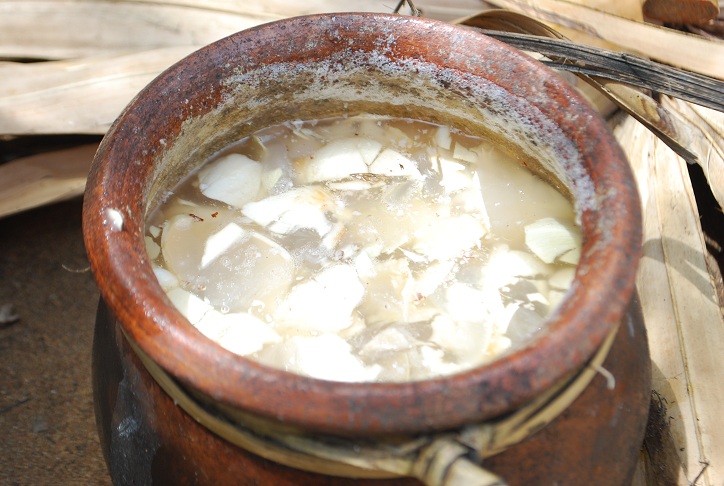
Neera with ice apple (nungu) in an eco-friendly pot
5.  Researchers in technology can be motivated to design an instrument to extract neera from palmyrah tree which would ease the risky job of tappers.


Along with my team, I tried several methods to encourage the tappers in their trade.  Through various steps like microinsurance, micro-credits, and developing innovative produce from the traditional palmyrah products, we are able to turn them into successful entrepreneurs in few villages of Tamil Nadu.  For example, we innovated a bread-spread from the traditional 'paagu' by mixing fruits like mango, papaya, and banana.  It is well-received by school children, adults, and even diabetic patients.  When I interacted with the palmyrah association leader in Tuticorin, he came forward with the idea of making flour from panankizhangu to make our traditional and tasty food and snacks like idli, upmaa, dosai, and murukku.  Even neera can be converted into powder by which we can make mix.  Researchers should come forward to analyze such products.

I strongly believe that only practical orientation could help palmyrah tappers to save the glorious palmyrah tree as well as their trade.  It is my long dream to have a model palm grove, where we can impart the technical skills to the tappers.  In this process, we have applied for Rolex Awards for Enterprise 2012, which support individuals, who involve themselves in creating better tomorrow for human kind.  From 1978, environmental projects have been awarded for 38 individuals.  Our project for palmyrah tree, which preserves the ecological balance, also has been selected in the pre-application process and I was invited to submit a full proposal, which I did.  When I share this privilege with environmental well-wishers, I urge everyone to take steps to save our state tree, which has 2500 years of history in our life, culture, and heritage.

***

Thursday, November 24, 2011

Recipe for Palm Leaf Kozhukattai


Ingredients:
Hand-ground raw rice flour - 1 kg
Palm jaggery in liquid form (vaarpu karupatti) - 3/4 kg
Grated coconut - One
Tender palm leaves - as required (minimum 25 to 30)


Method:
Mix the rice flour with vaarpu karupatti (liquid form of palm jaggery preserved in clay pot) and coconut, if required, add some water.


Clean the palm leaves and cut the center portion about 4 to 5 inch long.


Open the leaves and stuff the dough lengthwise and close the leaves. Tie with a thick thread. (You can use thinly cut palm leaves as thread). Finish all the dough like this.


Take a clay pot, pour water, keep small sticks and spread some palm leaves.  Then keep the kozhukattai preparations to boil in steam.  When it gets cooked, it is ready to eat. 


If you would like to keep it for 3-4 days, remove the palm leaves from cooked kozhukattai and keep it in a solavu (winnower) made out of palm leaf in an airy place.

Lighting Karthigai Dheepam with Palm-Leaf Kozhukattai


Kaarthigai Deepam [கார்த்திகை தீபம்] (celebrated December 08 in 2011),  is a festival of lights, celebrated in the Tamil month of Kaarthigai (Nov 17 - Dec 16 this year). It is celebrated on the full moon day of the Kaarthigai month.  In southern Tamil Nadu, it is a traditional practice that people make delicious 'panai olai kozhukattai' [பனை ஓலை கொழுக்கட்டை] made out of rice flour mixed with palm jaggery.  It is not only sweet, also sugar free, since the palm jaggery doesn't stay in the body.  This food is highly nutritious, which contains minerals and vitamins.  The speciality of this kozhukattai is that it is prepared covered by palm leaves and boiled in a pot; so it is eco-friendly.  Even today I could feel the taste of the kozhukattai with sweet smelling palm leaves.  It is culture-related.

We are to celebrate the festival in another few days, but I wonder if anyone will prepare this delicious panai-olai kozhukattai.  Even if so, they can be numbered.  Even if somebody wants to make this kozhukattai, where will they go for palm leaves?  No leaves?  Few years back, in southern districts, the community of palmyra tree toddy tappers used to make panai olai kozhukattai.  Also, it was easy for people from other communities to get palm leaves and palm jaggery to cook kozhukattai.  The toddy tappers would happily supply the palm leaves free of cost for brotherhood.  The situation has entirely changed now.  Very rarely the leaves are available in the market during this season.

People are not aware of the medicinal values of palm jaggery.  Its not just food.  Hence this practice, which was inseparable in our culture and heritage is slowly disappearing.  I am indeed panic over the fact that palm forests are destroyed.  Recently, I was discussing this issue with a celebrity, who also had similar painful experience of witnessing the deforestation of 45 acres of palmyrah forest, some years back in his birthplace, Sundaranachiyarpuram [சுந்தரநாச்சியார்புரம்].  Catholic priests those days felt that palmyrah toddy tappers are ruining their life and health by consuming palm toddy, which they considered as alcohol.  They thought they'll redeem the people from the practice by destroying the palmyra forest.  At least 8500 trees were cut.  Each tree takes minimum of 12 years to grow and yield.  They did not realize that it is not destruction of palmyra forest, but survival of a community, healthy environment, healthy food, medicine, and culture & heritage.  At the same time, the celebrity agreed with me that to change the practice of taking toddy, the palmyrah trees need not have been removed from Sundaranachiarpuram.  Our ancestors have taken pure toddy which is good for health.  If toddy is taken continuously for 40 days, it is good for eye sight.

Sweet idli, aappam, Toddy was used to make the mix sour.  Now yeast has replaced.  
During every season, we get some edible things from palm tree:
- From March to August, we get 'neera', contains lauric acid, which is found in breast milk.  So, its a natural health drink even for children.
- Palm jaggery and palm candy made out of boiled neera are good for cold, cough, asthma, cancer, and diabetes.
- Palm jaggery is preserved in another liquid form called 'vaarpu karupatti' in pots which they use for making sweets.  Whereas, palm jaggery is mostly used for making coffee.  This black coffee without milk can be consumed hot or cold anytime.
- Ice apple (nungu) is a cure for all diseases caused by heat in the tropical region like small pox.
- Palm fruit is not only tasty, but highly nutritious.

panankizhangu

- In the next season, i.e., from December to February, we get calcium and fiber-rich 'panai kizhangu', which is good for digestion.

In the life of Tamils, during all auspicious days, palm tree plays an inevitable role.  For marriage, palm fruits are used for decoration symbolizing the fullness of life.  A newborn Baby is given jaggery mixed with water as blessings from elders.

During Pongal festival, which is meant for Tamils, parents would present women colorful 'Seer Petti', a box made out of palm leaves filled with rice, sugar, coconut and other grocery essentials.  Now the colorful palm leaf boxes are replaced with harmful plastic buckets in this modern world.

It is high time to think about the emerging danger of losing palmyra trees, culture & heritage, survival and livelihood of palmyra tree toddy tapping community, which depends on palmyra trees for centuries.  When we welcome the modernity, let us take a pledge during this Karthigai Deepam, to go for reforestation of palmyra, our 'State Tree'.  Otherwise, we could witness the extinction of palmyrah trees which already happened in our neighbourhood state, Kerala.  As I conclude, let me remind volunteers of our Blaze Trust to join during Christmas holidays with us to spend with palmyra community, particularly with children.  Wish you a Happy Karthigai Dheepam. 

Saturday, November 12, 2011

Children Parliament

- Palmyrah Community Children Program -

We are constantly focussing on children parliament program for palmyra toddy tappers’ community children.  The children, who are entrusted with portfolios with education, environment, and health & sanitation, are seriously taking their assignments and doing amazing work in the localities.  Amidst the palmyrah toddy tapping hamlets, these children are encouraging the enrolment of dropout children to schools, thereby helping us in our mission of eradicating child labor, which is more prevalent in this community.


One group of children are following the environmental impact of our project.  They are very much delighted to do this work like monitoring the increased number of birds in the surroundings of palm forest and also change the mindset of the people of the community to go for solar lanterns to use during the season in the thatched huts in the middle of forest instead of risky and polluting kerosene lamps.  Hence now it is time for us to generate funds for the distribution of solar lanterns to the community before the starting of next season.


In some areas, plastic garbage are found along on the way to palm forest.  These children are motivated to clean and have green surrounding by planting palm seedlings.

We have decided to celebrate our Christmas and invest the whole of Christmas holidays along with the palmyrah toddy tappers, particularly with the children.  The important agenda is not only to conduct awareness program on their surroundings and environment, but also to take them to nearby eco-tourist spots like Manappaadu, a natural beach.  This beautiful place has its own heritage for palm crafts where women from fisherfolk community as well as palmyrah toddy tapping community are trained to make handicrafts from palmyrah leaves. We also planned to deepen the existing ponds in that area with the help of youth and children.  Apart from our members, whoever is interested to join in this venture can enrol their names by e-mailing us at TrustBlaze@gmail.com. This is an open invitation to take part in this noble mission.

Blaze Trust


- Another milestone in our journey -

I am immensely happy to announce to all the volunteers, animators, students, who immersed themselves in the projects, which we are executing in Southern Tamil Nadu, particularly for the partakers of the one that we are doing from the year 2005 for palmyrah toddy tapping community, the formation of our Trust - ‘Blaze.’

Your are playing a very vital role in the field works, workshops, awareness programs on palmyrah tree and its embodiment with the environment.  The recent update from palmyrah toddy tappers community from Chettivilai locality stands a witness to successful implementation.  The palmyrah season just got over, which started in the early March.  Our community are able to store their produce by following the traditional technique of storage revived and taught by us.  Hence, they are happy that they can get fair prices for their produce during the off-season.  You all will be happy to know that they came out of the clutches of the moneylenders and they all have bank savings now.

Palmyrah tappers in Karupur

Hope you all remember that this is the community which questioned us when we insisted on savings during our financial literacy programs, “We are struggling for one meal a day and you are talking about saving money in the bank.  That too, we live in a remote village where there is no bank at all.”  This magical change is done by all our systematized, and well organized implementation of the project.

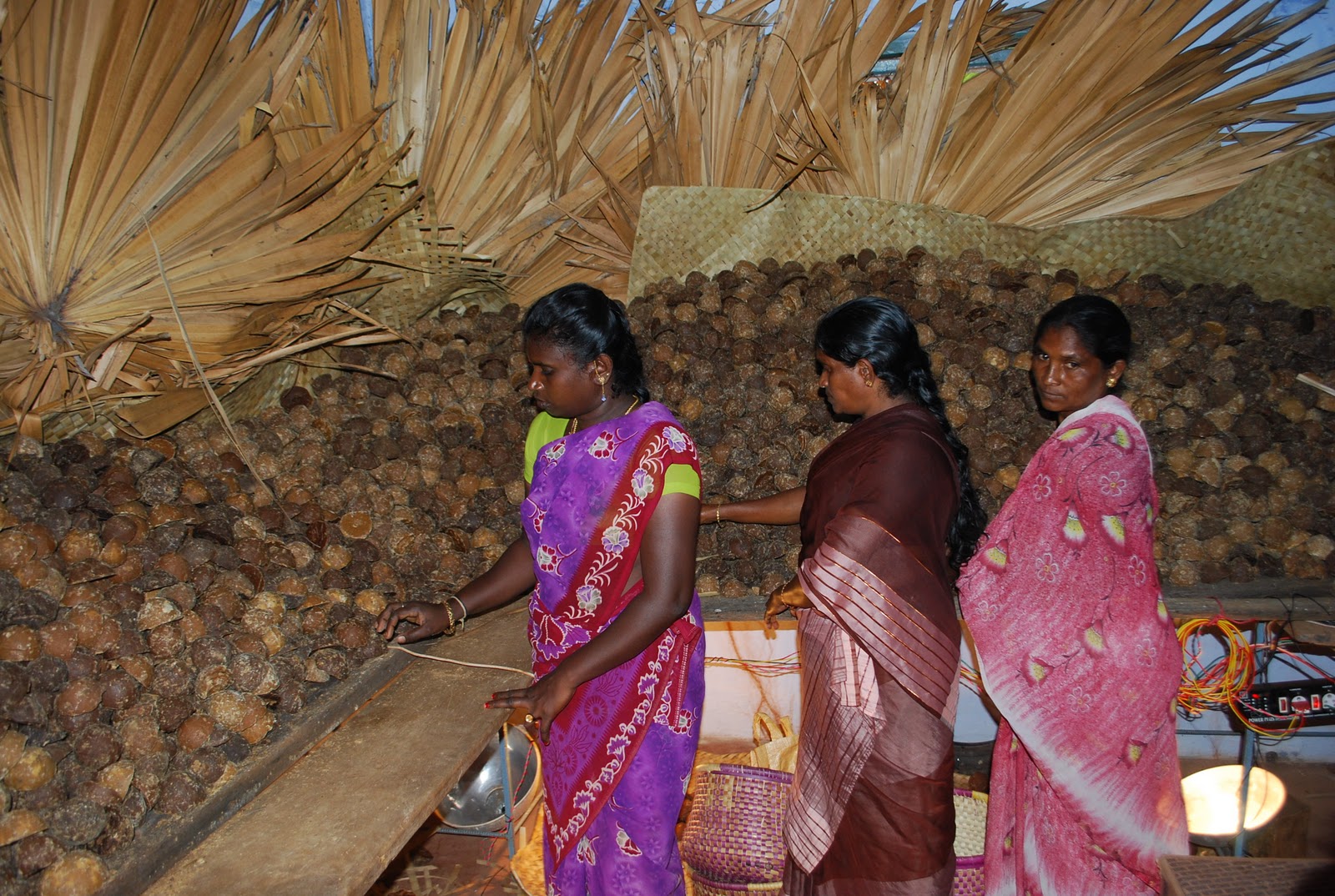
Happy Women from palmyrah community in an eco-friendly store room

We all felt that we can form an organization to carry out our project in a more effective and efficient manner.  After repeated discussions with all animators, volunteers, and the community leaders, palmyrah federations (that we formed), it is decided to go for a registered foundation.  Yes, due to our continuous effort, our Trust ‘Blaze’ is formed.  Hence, now we can go ahead with more enthusiasm.

While thanking all the active participants of this project, I earnestly request everyone to be with us and bestow your innovative ideas.

Saturday, November 5, 2011

Access to Internet! Access to lands!!


Two-thirds of India makes its living from the land. The earth, the most generous employer of our country, employs over a billion people both directly and indirectly.

The World Bank’s Structural Adjustment policies leading to seed monopolies, the Free Trade policies of the World Trade Organization leading to a dramatic fall in prices and the Indian Government’s Special Economic Zone Act of 2005 leading to large-scale land acquisition have all pushed the Indian peasants to a crisis of survival.

Our state, Tamil Nadu, holds together more than 50 million people; among them more than 70% of the population depends on agriculture. In our state most of the farmers are resource poor and the farm activities are carried out through lake and well irrigation. Employment generation is possible only through the farming sector by increasing the cropping intensity and by integrating other farm enterprises.

It is famously said in India, “Farmers are born in debt, live in debt and die in debt.”  The year 1997 noted the first cases of farmers’ suicide in India.  Approximately 17,060 farmers committed suicide in India in 2006. 86% of those who committed suicide were debt-ridden. 34% debt-ridden farmers found money lenders extraction methods humiliating. 77% were 36 years old or above. 31% has mortgaged their land.

The river Thamirabarani is known as 'vattraadha Jeevanadhi' (வற்றாத ஜீவநதி)- the life-giving river, where  more fertile lands are available in the surrounding area.  The villages of Tirunelveli are ever-green lands where I was born, brought up, and studied.  I was very much disturbed when articles appeared in the newspapers regarding suicide of farmers because of the debt, popularly known as Kandhu Vatdi (கந்து வட்டி).  My research along with the students unit in college named 'SIFE', revealed some disheartening facts.  Even the farmers are not able to buy pesticides or fertilizers when the mortgage their lands to moneylenders and they are not able to retrieve the money spent.  The consequence is that they commit suicide.  Interactions with farmers as well as advisers encouraged our team to execute a project in southern districts of Tamil Nadu to help small farmers.  Thanks to Entomology Research Institute, Loyola College, Director, Dr. Ignacimuthu, and fellow scientist Dr. Maria Packiam, for invention of the biopesticide PONNEEM, which is a boon to farmers.

My students, under my guidance, distributed the biopesticide in northern districts of Tamil Nadu.  After witnessing the results, we zeroed-in to Tirunelveli District.

The villages of Tirunelveli suffer from acute poverty. Due to unemployment, the people resort to unsafe migration to urban areas which leads to scattering of families. The women are forced to work in hazardous occupations like the beedi rolling industries which cause severe health problems such as tuberculosis, asthma and cancer and even severe harm to their reproductive system.

After a thorough analysis and an in-depth study of various socioeconomic and demographic indicators of Tirunelveli, we identified the following problems and needs of the small farmers in Tirunelveli:
- Inability to purchase pesticides leading to severe pest menace, therefore the need for affordable and eco friendly pesticides.

- Overwhelming illiteracy and ignorance of government schemes, therefore the need for awareness about government welfare schemes.

- Rampant poverty and reliance on exploitative money lenders, therefore the need for government aids and loans.

- Poor productivity because of depleted soil, therefore the need for eco friendly fertilizers and biopesticides.


Hence, we decided to train the farmers to prepare the herbal formula, PONNEEM, a combination of Neem and Pongam oil, on their own.  We named it EcoGreen.  We felt proud that we had taken the lab to land or the scientific technology to rural farmers. On the contrary, we realized, during the course of time, after interaction with elderly people, the fact that this herbal formula is nothing new to them, but a forgotten age-old practice.

It is quite interesting.  We started learning several other organic farming techniques from them and revived among them.  We started in 10 villages among a small number of farmers and we are now able to reach hundreds of villages.  This herbal formula is proved to be beneficial and cost-effective, eco-friendly, and increases yield.

Yet, we felt that some major factor is lacking in our initiation.  After rigorous discussions, we came to a conclusion that these farmers must have the knowledge economy i.e., information; the reason being, the Agricultural Department of Tamil Nadu has opened a website exclusively for information to farmers.  In the villages where we work, they do not have access to computers and/or internet.  In the first phase, we selected 5 villages and distributed computers for internet access.

At first sight, they thought computer and TV do the same, but slowly they realized the potential of the information technology with the help of my students and the first generation trainers trained by us.

This would revolutionize the ways of farming in rural Tamil Nadu by enabling the farmers to be aware of
1.  Seed prices of various crops
2.  The market rates of crops
3.  Use of weather forecasts
4.  Upcoming and present government schemes.

I am really happy that me, along with student community, are able to bring smiles on the face of poor farmers.  Now, the farmers are able to access internet as well as their lands successfully.  I am grateful of Erbacher Foundation, Germany, for the grant of €25,000, which helped us for successful completion of the project.

Monday, September 26, 2011

Would Rolex Awards Save My Mother?

Anyone who reads this title may get perplexed and ponder over this question WHAT ROLEX AWARDS HAS GOT TO DO WITH MY MOTHER?  I would like to confuse again with another statement:  "I have two mothers!"  People who understand the history, literature, and ancient culture of Tamil could get my point.  In our literature, it is narrated that the girls have two mothers, one is the biological mother, and another is the mother called Sevili Thaai (செவிலித் தாய்), who nurses or brings the child up.  She narrates stories, teach moral values, feed nutritious food, and guide the child all along the life path.  Now tell me about my second mother.

She gave me sweet & healthy natural drink, delicious fruits and snacks.  It was from her that I got my toys to play.  The cradle, walker, cot, bed, baskets, hat - everything she presented to me.  It is none other than the glorious palmyra palm tree, which has its roots in the history, culture, and heritage of Tamils for more than 2500 years.

Palmyra palm tree, the wonder of nature, is fondly called Karpaga Virutcham (கற்பக விருட்சம்) of the world which means the tree which gives whatever the people ask for.  The saddening fact now is that the mother is left in the lurch by her own children.


I have taken it as my commitment to save my mother, who brought me up teaching the philosophy of life.  She takes care, not just the people, but serves a sanctuary to birds, preserves biodiversity, checks soil erosion, beautifies the seacoast.  When I ventured into this task in the year 2005, only few people encouraged and motivated me.  I should be grateful to Rev. Dr. Albert Muthumalai, Principal (2004-10), Loyola College, for his venerable guidance and Dr. K.S.Antonysamy, the then Dean of Students for all his valuable inputs.  Only with their support, I was able to overcome all the hurdles in the stream of this project.  My project coordinator, Samson Durai, and students helped me with innovative ideas in the implementation process.  Nevertheless, in all these years, to be very frank, I was able to succeed only a few miles.  When I saw the announcement of Rolex Awards 2012 in the website, I got a ray of hope that my dream of saving my mother will now become true.

My students in interaction with a woman from Palmyra Tappers community

Yes, the hope has now become stronger.  I am indeed proud to inform all my well-wishers that my pre-application for the Rolex Awards for Enterprise 2012 has been picked up and I was invited to submit the full proposal, which I did.

Established in 1976 to foster a spirit of individual enterprise around the world, the Rolex Awards recognise pioneering projects that demonstrate innovation and contribute to the betterment of mankind.

Mr. G.R. Gopinath Iyengar was the first gentleman from India who had obtained Rolex Award for Associate Laureate in 1996.  I was inspired by his project to expand ecological silk-farming to improve living standard of farmers by adapting the original Japanese method only after reading it through Rolex Award.  I was able to successfully adapt and replicate his project in some parts of Tamil Nadu during the years 2004-06.

This year alone, Rolex has received more than 3500 applications.  I feel that it is a great honour for me that my pre-application has been selected for further consideration.  With overwhelming joy of being given the chance to submit a detailed proposal to the Rolex Secretariat, I am dreaming all day and night with hope that Rolex Awards would save my mother!

Friday, August 12, 2011

My Grandma and Palmyrah!

My maternal Grandma, Magadalena Mary, was my best friend from my childhood who taught me the philosophy of life.  She was a mother of 11 children and grandmother of 48, but I am certain that I was the most favorite among them all.  I was not regular to school till Standard IV (middle school), but learnt a lot from her.

There were various kinds of trees & flowers in her home.  The most fascinating favorite, for me, was the palm tree in the backyard.  There was a well without walls, but full with water anytime of the year.  She'll make me to sit under this palm tree while washing the vessels.  This was the time that I had the opportunity to listen to some most interesting stories.  While listening to her stories, I'll enjoy watching birds like palm swift building their nest.  Most of the time, ripened ice apple ('Kadukaai', கடுக்காய் in Tamil) falls from the tree.  I would run to pick it and eat, but my Grandma would never allow me to eat them.  The reason she would tell me, "Ice apple is good for health, but not Kadukaai (ripened Ice apple).  It will cause stomach ache."  Her explanation would not suffice the adamantly screaming child that wants to eat them.  Grandma immediately would ask my uncle to bring ice apples from her palmyrah tree farm.  Imagine a 3-year-old kid eats 10 to 15 ice apples a day!  But that was what I was having for my breakfast, no wonder.  And there brings grandma, my coffee, made of palm jaggery.  Oh! how I love it!  The very taste still waters my mouth.  When its eleven in the morning, I'll get hot 'padhaneer kanji' (பதநீர் கஞ்சி) made out of the natural drink neera from palmyrah and rice.  In the evening, I get palm 'kilangu' பனங்கிழங்கு and palm fruit.  Needless to say, I grew up as a healthy girl getting all the nutrition / vitamin from all edibles from the palm.  The palm fruit, especially, is very delicious.  It subsides the excess heat generated in the body.

Panai Jaggery is being prepared from Palm Juice

Every year, my grandma used to plant new palm saplings.  I remember, once, I asked her this question, "Why are you doing it as a custom?"

Her answer was, "Don't you like the palm fruit?  ice apple? palm candy?"


"I love them grandma!"  I answered.


She then asked me "Don't you like the pond of our village?"

"Sure!" I said, "Its full with beautiful lotus.  The ever-living waters where you taught me swimming."

Now she said, "To save the traditional tree which is bound to our culture and heritage, my dear, we need to plant more."  She went on to say in her own style, "Planting palm tree preserves mother earth, nature, the water bodies like our village pond.  Do you know, my child, this tree is the best friend of mankind?  Let me tell you... each and every part of this tree is used in one way or other."

Yes, what my grandma said was absolutely correct.  Even now, as I re-live that evergreen talk, I remember, I was fanning the breeze with palm leaf!


Not long after that conversation, it was time for my grandma to say goodbye to this world.  After her, I was brought up in town and never wanted to visit the village again.

Several years later, I had to visit the same village for some cause.  Wait...! Did I say 'same village'?  No, it wasn't the same.  While my heart pounded to see that pond, that palm tree, and the beauty of the place, I never thought that I would see what I saw.  To make the long tragedy short, most of the palm trees in that village were cut, for money, by the farmers themselves who planted it.  They've gone to look for alternative trade.  I couldn't locate the pond.  People showed me a thorn bush and said that's where the pond used to be.  I had to return absolutely disheartened.  Since then, my mind was contemplating over this loss and I ended up making a decision.

Not long after..., I started learning the uses of palm tree and started working with the palmyrah farmers.  Thanks to my profession, being a professor, I invest at least a part of my lecture, to inculcate environmental consciousness, awareness, and values.  For the past six years, I have engaged my beloved student community with palmyrah tree toddy tappers in Tirunelveli and Tuticorin Districts.
Me and my students with palmyra toddy tapper in the field.

I gratefully acknowledge my friends and supporters, Dr. Sethu Kumanan, Chairman, Sethu Bhaskara Group of Institutions, Mr. Bharathi, Director, RUDSET, and my co-worker, Samson.  Now, I am happy to see my grandma's assignment continued with farmers planting palm seedling.  This has made me feel that I have successfully crossed few milestones, but I agree with Robert Frost when he says, "Miles to go before I sleep."

The palmyra tree is one of our nature's best defense mechanism that can be saved; as well as our planet.